
Keep Up or Burn Out: A People Leader's Survival Guide to the AI Age
AI is changing everything about how we manage people. This flagship guide for mid-level managers covers the mindset shifts, skills, and strategies you need to lead your team without burning out.

People leaders are in the most uncomfortable sandwich. On the one hand, your team is anxious about everything and is looking to you for all the answers on how to navigate the Age of AI. Plus, you're feeling the top-down pressure to figure out how to squeeze all the goodness out of the new batch of AI tools and agents.
"Productivity gains!"
"What should I do, boss?"
"How soon do you think we will see the ROI?"
"How do I make my career future-proof?"
And in the 10 seconds when you're not thinking about everyone else, your own self-doubts and anxieties pop in: "How do I keep up? There are so many new things to juggle. What happens if I can't do this for much longer?"
Managing people in the Age of AI is different: it's not only about managing people through a wholesale transformation of how we ideate, design, and deliver our work, but also about managing AI Agents. It's about how our people need us to reassure them with certainty, even when we have none. It's about how our ELT's vision for AI needs to translate into successful outcomes for our team; kinda like we're still paving the road and putting a steering wheel on the supercar while it's already going 100mph.
Let's address three elephants:
1. You do not need to have all the answers.
Your people keep asking for your certainty. They sidle up to you like a warm fire and ask, "Tell me what to do. I need to know everything is going to be ok."
You have permission to tell them the truth: that you do not know. That you are also figuring it out. Managing people in the Age of AI requires clearer communication because everything else is so fuzzy.
What your team actually needs to hear is, "Things are really challenging right now. I know you're exhausted and worried. I don't have all the answers, but there is no question that we are going to figure this out together."
This mindset shift is a game-changer. Relieve yourself of the burden of having to be certain. Instead, be confident in your ability to figure it out.
2. Your executive team can handle the truth.
Managing people in the Age of AI means managing up with calm confidence, too.
Listen, your ELT is answering to the Board and the Investors, all of whom expect to see the promised magical new world of high productivity and steady profits that AI scions are preaching about. Some execs have a clear understanding of how to make it a reality, but actually, we're all in a real-time sandbox, playing with new tools. Very few people have anything dialed in.
They already know this. Most people do not become executives unless they are comfortable with uncertainty. So when they ask you for an assessment about when we will see positive outcomes and solid ROI, you have permission to tell them the truth.
That call to clear communication applies to your leader(s) as well: "We don't have a firm timeline yet. As you know, this involves a lot of experimentation, and we are still testing our AI Agents and the new systems. But I will continue to communicate about our progress and outcomes. Here are some early indicators: [X, Y, Z]."
This is a gentle reminder to avoid over-explaining, justification, or otherwise communicating a lack of confidence. Be clear, competent, and confident. This is a skill to continue to invest in. Your leaders will respect you more when you tell them the truth confidently and set boundaries for your team.
3. Your body is trying to tell you something.
There's a powerful conclusion from neuroscience research on burnout: your body has a stress cycle, and you haven't been completing it.
The physiological response to a stressful event is hard-wired. In fact, our bodies respond to a stressful event the same way they did for our evolutionary ancestors. So that exec email asking you for ROI on AI spend - your body is responding to it as if it were a literal tiger attacking your family.
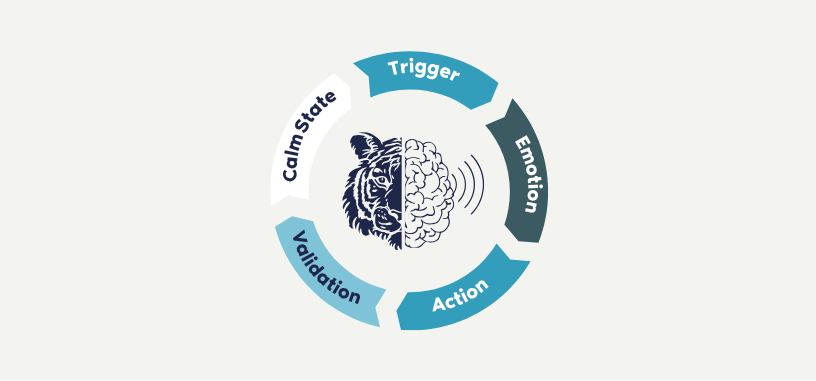
The Stress Cycle needs to be completed to avoid burnout. How are you receiving the Validation necessary to return to a Calm State?
The research shows that we are stacking stress cycles, and because we never complete these cycles, we end up in burnout. This is largely because we evolved as a social species to go through stressful times as a community. We show up for each other, validate each other's pain, and return to a calm state together.
But we don't operate that way in modern society. We are experiencing stressful events alone and often lack the words to explain why they were so stressful, so we don't get the validation we need, and therefore never complete the cycle and return to a calm state. At some point, you get overwhelmed and check out, run away, or lash out. That's burnout.
Even great people leaders deserve support, too.
When was the last time you filled your own cup?
If you had to pause and think about it, then it's already been way too long.
I know, from personal experience, that your body will eventually cash all those checks you've been writing to push through, one more week. One more project. One more. And another and another.
To successfully manage people in the Age of AI, you will need a strategy to create space for yourself and to regularly fill your cup. Because you cannot sustain this pace and this amount of pressure. It's better to do maintenance than to rebuild a whole life.
Strategic Ideas to Fill Your Cup
Expand your joy. Joy is the fuel that will get us through this time of transformation.
Create sacred time for yourself. Allow no one to schedule over that time. Do something juicy for yourself.
Identify hobbies you always wanted to try. Spend 1 hour this week doing that hobby, and congratulate yourself for trying it!
Spend time in nature and seek awe. Go for a walk in a beautiful place and look for something that inspires you, like a beautiful flower or an incredible sunrise.
Get creative and playful. Think about kindergarten: what activity did you love? Spend time this week doing that thing. Even finger painting. Just have fun.
Have a "selfish" day (or hours). Do absolutely nothing for anyone else. Ignore everyone else's wants/needs and do whatever makes you happy.
Schedule time with me. Get a research-backed sounding board, feedback loop, and solution incubator. Empathy is my superpower.
How do you fill your cup? What's working for you?